CLO for Apparel Line Review: Strain Maps and Swatch Evidence
CLO suits line reviews needing pattern-linked visualization and fabric-specific stretch diagnostics, with guidance on swatch digitization and MDS eligibility.
For a line review that needs pattern-linked design visualization and fabric-specific stretch diagnostics, choose CLO.
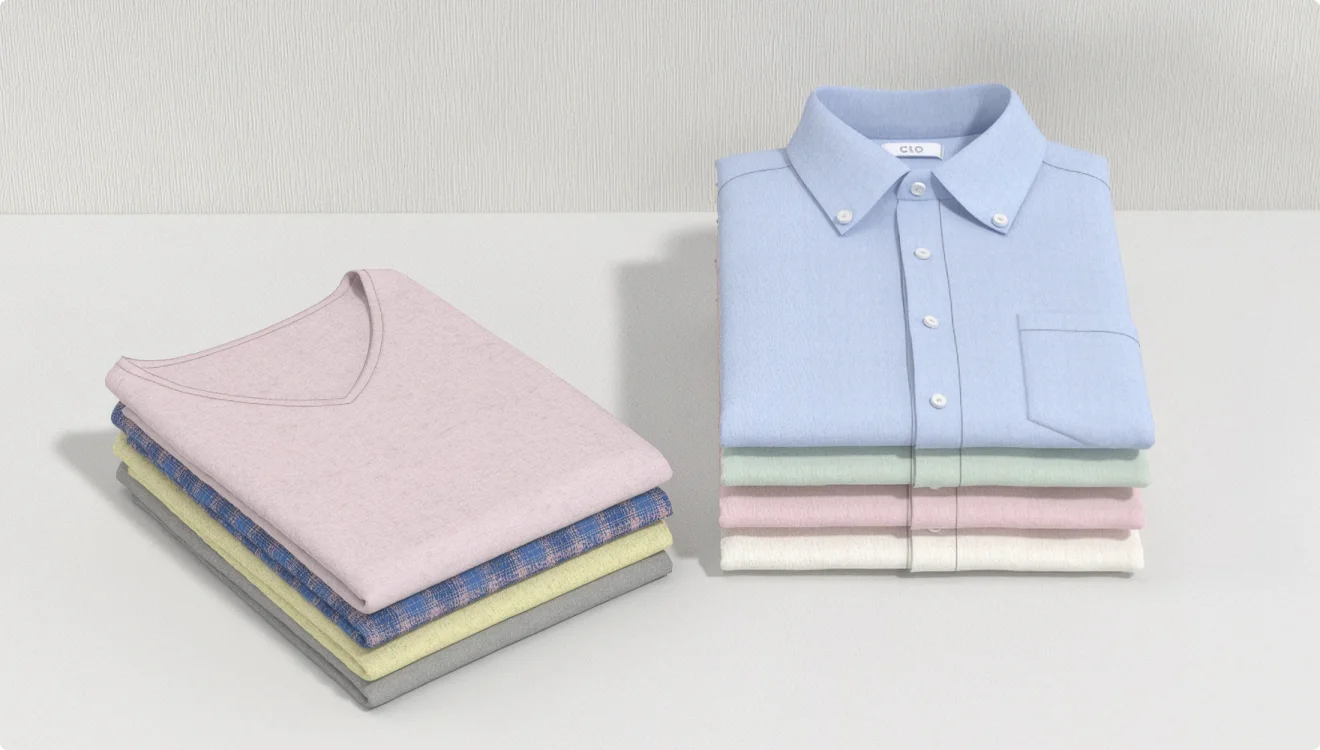
- Use its garment view to discuss fit, fabric appearance, and silhouette alongside pattern changes.
- Use Fabric Mode in the Strain Map to read stretch demand against the fabric’s stretch limit.
- Route a proprietary physical swatch through Fabric Kit or MDS when the review needs that specific material digitized.
- MDS is a company service for organizations that qualify for CLO Business; one-person companies are ineligible.
What evidence does this line review need to approve?
A line review needs evidence that matches the decision: visual direction, a pattern-linked change, fabric stretch behavior, or a simulation based on a named physical swatch. CLO fits this review when the team wants garment visualization with a pattern context and fabric-specific stretch diagnostics. CLO’s product overview describes visualizing a design’s fabric, fit, and silhouette; the practical decision is to pair that view with the material evidence your approval question requires.
Separate four review questions before the meeting. First, does the design communicate the intended silhouette and visual direction? Second, does the pattern change produce the desired garment shape and fit? Third, does the chosen material’s stretch behavior suit the areas under review? Fourth, does the digital fabric correspond to the physical swatch the team selected? Each question calls for a different piece of evidence, even when one garment view helps the team discuss several of them at once.
A garment image can make design intent easy to discuss. A line-review lead can use it to focus comments on visible features such as silhouette, proportion, and the appearance of fabric across the garment. Pattern-linked views help connect those comments to a pattern revision. A Strain Map gives another lens on stretch behavior, while a specific swatch digitization route answers whether the material in the simulation was built from the chosen physical fabric.
A garment-modeling paper in Computer-Aided Design and Applications describes a model that combines 2D pattern profiles, multilayer parts, fabric mechanical properties, and details such as seams, darts, and buttons. The paper also models assembly steps such as sewing panels and placing a garment in 3D. These inputs explain why a review record should identify the pattern and material behind the garment view.
A 2025 study of 30 fabrics used for flared skirts found thickness, bending rigidity, drapability, and shear performance among the primary material parameters associated with pattern dimensional accuracy in that study. The authors also reported that the measured garment lines at the bust, waist, and hip could differ from corresponding lines in the 2D base pattern because fabric deformation relates to the fabric’s mechanical properties. For a line review, this is a useful distinction: a silhouette view communicates a design result, while material inputs explain part of the behavior that shaped it.
Use this short intake list before approving a visual or fit direction:
- Visual question: Which silhouette, proportion, or fabric appearance is the team reviewing?
- Pattern question: Which style, pattern revision, measurement, or construction detail is under discussion?
- Stretch question: Which fabric’s stretch limit and mapped garment area inform the diagnostic?
- Swatch question: Is the digital fabric an available emulated fabric, or was it created from the physical swatch under review?
- Approval scope: Is the decision about design direction, pattern development, stretch behavior, or a particular material match?
Naming the approval scope helps the team use visualization and diagnostics as concrete evidence. It also gives later reviewers a clear record of what the meeting approved and which source material supported that decision.
When does pattern-linked visualization answer the design-review question?
Pattern-linked visualization fits a review where the team needs to connect a garment’s appearance with edits to a CLO pattern. CLO’s Pattern Drafter documentation says patterns created with Pattern Drafter can be edited while retaining their original parameters. The workflow gives a reviewer a path to assess a design change alongside the measurements that define the parametric pattern.
For patterns created in Pattern Drafter, the documented editing route lets a user change measurement values while retaining the pattern’s original parameters. The manual also describes Edit POM, or Edit Point of Measure, as a way to update the parametric pattern while maintaining its parametric relationships. These connected capabilities help a team review a measurement adjustment and the garment view using the same pattern context.
A direct pattern edit has a specific effect: CLO’s manual says it breaks the pattern’s connection with Pattern Drafter. For a line review that needs to retain that connection, make the change through Pattern Drafter or Edit POM. This is a practical control for keeping the pattern-edit path clear when the team revisits why a measurement changed.
Consider a hypothetical review of a skirt waist measurement. The team records the pattern revision and the proposed measurement change, then uses the documented parametric editing route and reviews the resulting garment view. The discussion can then address the revised shape in context, with the starting pattern and edited measurement named in the notes.
Pattern-linked visualization answers questions such as these:
- Does the revised pattern preserve the intended line and silhouette?
- Does a specific measurement change move the garment in the intended direction?
- Does the modeled seam, dart, or overlapping-layer detail match the feature under review?
- Is the pattern revision clearly tied to the garment view being approved?
Record the pattern identifier, revision, and changed measurements next to the view used for review. When the team compares more than one fabric or construction, identify those inputs for each view as well. That simple practice makes later comments easier to connect to the version that generated them.
What does CLO’s Fabric Mode Strain Map show during line review?
Fabric Mode shows the garment’s stretch demand against the selected fabric’s stretch limit. CLO’s Strain Map manual states that Fabric Mode uses each fabric’s stretch limit. CLO also says the wearable stretch limit is automatically calculated and applied from the fabric’s physical properties when using the Stretch setting.
The map gives reviewers a visual way to locate areas where the garment’s simulated stretch approaches the configured fabric limit. CLO describes the displayed range as starting at 100%, meaning no strain, and extending to the fabric’s maximum stretch in eight segments. The color gradation presents the range across the garment.
Use the map as a fabric-specific diagnostic in the design review. Start with the intended fabric assigned to the garment, then display the Strain Map in Fabric Mode. Inspect the mapped regions that relate to the team’s fit or movement question.
A strain percentage is most useful when reviewers interpret it with the fabric’s physical properties and the garment area under discussion. The garment view and pattern revision then provide design context for deciding whether that location warrants a pattern adjustment, a different material choice, or further review.
The ASTM D3107 standard covers stretch, growth, and recovery in woven fabrics made wholly or partly from stretch yarns after specified tension and extension. ASTM describes its intended use for woven fabrics with stretch greater than 12% and good recovery under low tension, up to 360 g/cm or 2 lb/in. of fabric width. The method includes separate calculations for stretch, growth, and recovery, which can be selected according to a specification.
The Strain Map relates garment stretch to the selected fabric’s limit, while a physical textile test can report stretch, growth, and recovery under a specified method and load. For a woven stretch fabric in ASTM D3107’s stated scope, the standard’s test result gives teams a defined physical measurement to associate with the digital material record.
A useful review sequence is:
-
- Record the fabric ID and whether it is an available emulated fabric or a digitized swatch.
-
- Save the Strain Map mode and setting with the review image.
-
- Link each comment to the pattern area or material question it addresses.
-
- State whether the decision covers visual direction, simulated stretch behavior, or physical test results.
-
- Name any follow-up, such as a pattern edit or physical-material test.
When should a team work with an emulated fabric, and when should it digitize a physical swatch?
Use an available emulated fabric when the review is about design direction and the material option in CLO serves the team’s current visual and simulation question. Choose digitization when reviewers need the simulated material to correspond to a specific physical swatch. CLO’s fabric-swatch help page says CLO includes default emulated fabrics and CLOFAB; it identifies Fabric Kit or MDS, both additional-charge routes, for accurately simulating a physical swatch.
An available digital fabric can support a design conversation where the team is evaluating silhouette or exploring an intended material direction. A named swatch becomes the appropriate input when the approval question depends on a particular supplier material, fabric lot, or tested physical sample. The team can then keep the material identity attached to the garment view and the discussion of stretch or drape.
In a study of nylon fabrics, researchers measured physical fabric properties with Kawabata systems and CLO fabric kits, then used the kit measurements as inputs for CLO program. The nylon-fabric study found that bending and shear had the highest correlation with drape ratio among the properties it analyzed. The study also reported similar morphology between real and virtual fabric images and found that converting measured values into a database could reduce their differences in its tests.
Link the physical swatch ID, measured properties, and digital fabric record whenever a line-review decision turns on that material’s drape or stretch behavior.
A separate study using VStitcher tested three cotton fabrics in plain, twill, and satin weaves. In that study, bending stiffness had a significant effect on drape coefficient, while changes in thickness, elongation, and shear had minimal effects under the study’s tested conditions. Record the tested fabric and parameter settings with a virtual drape comparison, because the study found different parameter effects across the three plain, twill, and satin cotton fabrics it tested.
A study comparing measurement approaches for linen-cotton fabric provides another practical example. The authors measured two fabrics with plain and satin weaves using FAST and conventional equipment, then applied the data to garment simulations. The study’s material tests and simulation comparison included weight, thickness, extensibility, shear, bending, and compression properties. For the tested satin fabric, the simulated skirt and physical prototype showed many similarities even as some low-stress measurement results differed between methods. The lesson for a line review is to document the material inputs and method, rather than treating a generic label such as “satin” as a complete record of fabric behavior.
MDS has the company eligibility conditions described below, so teams considering that route can confirm eligibility before scheduling swatch work.
How does CLO describe validation of a digitized material?
CLO’s MDS page lists weight, thickness, physical-property measurement, and texture scanning among its material-digitization methods. The Material Digitization Service page describes a Drape Test that compares physical and digital fabric samples under matched conditions. The table summarizes the service’s sample setup and comparison checks.
| MDS Drape Test item | CLO’s published method |
|---|---|
| Sample size | Physical and digital fabric samples are each cut to 50 × 50 cm. |
| Test setup | The samples are placed on same-size physical and virtual cylinders. |
| Drape height | Height is compared from the floor to each corner of the drape. A difference of 1 cm or less is treated as accurately reflecting the physical properties; a greater difference leads to manual parameter adjustment until the difference is below 1 cm. |
| Flare count below eight | Physical and digital samples have the same number of flares. |
| Flare count of eight or more | The difference between the physical and digital flare counts is no more than one. |
The table reports CLO’s service method and its stated checks. It gives a team a concrete way to understand the validation statement attached to an MDS material: sample dimensions, cylinder setup, drape height, and flare count are part of the comparison. A line-review lead can preserve the material ID and these method details alongside a garment view that uses the digital material.
The separate Indian Standard IS 8357 assesses fabric drape using a circular specimen that hangs under gravity and a recorded shadow area, providing a conventional test context for CLO’s service-specific cylinder comparison.
Can this team use MDS, and how does the service enter the decision?
MDS is an ancillary service for companies that qualify for CLO Business. CLO’s service eligibility and ordering page says one-person companies are not eligible for CLO Business, and its help material describes MDS as one of the additional-charge routes for simulating a physical swatch.
CLO describes MDS as a service for digitizing a material library and organizing digital materials through swatchbook or CLO-SET. Teams managing proprietary materials can use that stated purpose to assess whether MDS fits their material-record workflow.
The published order path gives a team clear planning steps:
- Contact swatchbook to place an MDS order.
- Prepare and send labeled material to the swatchbook Digital Lab.
- swatchbook confirms material quantity and quality, after which the invoice is issued on the website.
- Schedule from the fabrics’ arrival at the Digital Lab. CLO lists estimated lead times of up to 5 working days for 1–10 materials, up to 10 days for 11–50, up to 20 days for 51–150, up to 30 days for 151–300, and up to 50 days for 301–450.
Before starting, a line-review lead can resolve three planning questions:
- Eligibility: Is the organization a company that qualifies for CLO Business?
- Material scope: Which specific swatches need digitization, and how will each piece be labeled against the team’s material records?
- Meeting timing: When will the physical materials reach the Digital Lab, and when will the team need the corresponding digital fabric for review?
CLO says resulting zFab files can be downloaded from CLO-SET or swatchbook. CLO is the design and simulation software; CLO-SET and swatchbook are the material-data destinations listed for these files.
How can a line-review lead close the decision with the right evidence path?
Choose the evidence route that matches the approval question: use pattern-linked visualization for design and pattern decisions, Fabric Mode for a fabric-specific stretch review, and a digitized physical swatch when the decision depends on a particular material. CLO’s Pattern Drafter and Strain Map support the first two review needs, while its swatch guidance identifies Fabric Kit or MDS for physical-swatches.
- Name the decision. State whether the team is approving visual direction, a pattern revision, a fabric-specific stretch question, or a named physical swatch.
- Attach the evidence. Save the digital fabric ID or physical test result used in the review.
- Connect approved changes to the pattern. Name the pattern revision that carries each accepted change.
- Preserve the diagnostic. Save the relevant Fabric Mode image when stretch behavior informs the decision.
- Assign the follow-up. Name the next action and its owner, such as reviewing a pattern adjustment or receiving a digitized swatch.
For an MDS material, attach its validation record to the garment and pattern revision that used it. For a physical test, attach the method and reported result to the style record. Add the review date, reviewers, decision, and named follow-up owner.
For example: “The team approved the silhouette and Pattern X revision shown, reviewed the assigned fabric’s Fabric Mode Strain Map, and assigned a named physical-swatch record for material-specific follow-up.”
For feature setup details, ask CLO AI Chat for more details. To explore CLO for your team’s design-review workflow, visit CLO.
FAQS
Questions line-review teams ask next
Is Fabric Mode the right view for every fabric decision?
Fabric Mode is the relevant Strain Map setting when a team wants to compare simulated garment stretch with each fabric’s stretch limit. For decisions about a named physical swatch, use the corresponding digitized material record as well, so the map is attached to the material the review intends to evaluate.
Does an available emulated fabric support a line review?
Yes, when the review concerns design direction and the available material asset is suitable for the visual question. CLO includes default emulated fabrics and CLOFAB, while its support page identifies Fabric Kit or MDS for a physical swatch that the team needs represented in the software.
Who can use CLO’s MDS service?
A company that qualifies for CLO Business can use MDS. CLO states that one-person companies are ineligible for CLO Business, and its service page directs customers to swatchbook to place an order.
What should the team save after approval?
Save the pattern revision, material ID and source, garment view, relevant map setting, review date, decision, and any linked physical test or MDS record. Those items let later reviewers trace the approval to the version and material evidence discussed in the meeting.
Product details, pricing, and features in this article are based on CLO’s official materials at the time of writing and may change.
Learn More
See how these criteria hold up on the real thing.
Related reading