2D/3D CAD Pattern Making Software: Measurement-Based Drafting, Multi-Size Grading, and Real-Time Drape Simulation
Compare measurement-based pattern drafting, multi-size grading, 2D/3D synchronization, and fabric review workflows before selecting apparel CAD software.
Key takeaways
- Measurement-driven parametric drafting links supported pattern geometry to entered measurements; review the generated shape, ease, and seam relationships.
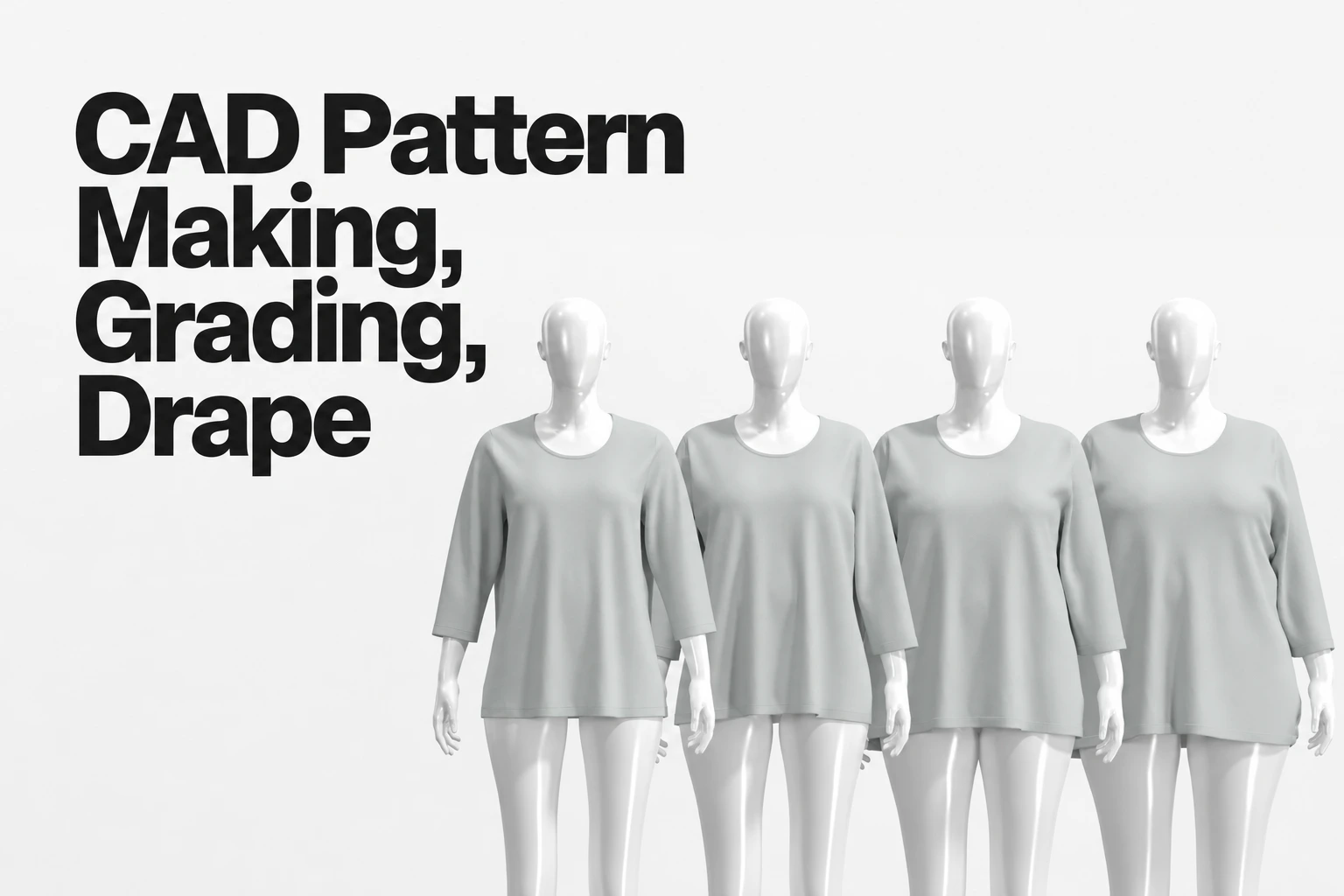
- Measurement-based multi-size grading enables technical designers to enter full measurements or increments across size runs and review corresponding seam lengths.
- Connected 2D/3D workflows help review geometry and simulated garments; direction, supported operations and simulation steps differ by product.
- Fabric and knit tools support fit review through fabric-aware Strain Maps, knit swatch controls (wales, courses, gauge), and friction adjustments for layered garments.
- Downstream production interoperability includes DXF-AAMA/ASTM export, structured Bill of Materials (BOM) export, and marker nesting consumption calculations for manufacturing handoff.
Measurement-Driven 2D Drafting and Parametric Pattern Generation
Pattern drafting connects measurements with geometry, ease and construction. A systematic review of material parameters explains why fabric inputs and their measurement matter to apparel simulation. Compare the selected software’s actual drafting and simulation controls.
The mathematical derivation of pattern blocks varies significantly across software architectures:
- TailorMetric describes formula-based patterns from measurement profiles stored in centimeters, with recalculation after measurement changes. Inspect the selected assembly’s required measurements and generated shape.
- CLO’s Pattern Drafter generates 2D patterns from user-entered measurements. The system creates Points of Measure (POMs) for the defined measurements and generates editable grading results for simulation and pattern refinement.
- Bok CAD MTM describes adjusting base patterns from customer measurement tables, including rules for varied body postures. This is a vendor-described workflow; validate the result on the intended customer and garment.
- Browzwear provides an interactive environment where technical designers can draft in 2D and drape in 3D in real time, validating sizing, drape, and proportion across a full size run before physical sampling (VStitcher).
- Optitex PDS documents pattern editing, grading and connected 2D/3D workflows. Confirm the particular measurement and size-comparison tools in the chosen module.
- Lectra Modaris Expert offers parametric pattern capabilities designed to streamline pattern modifications, which Lectra reports can save up to 30% of pattern-adjustment time.
Compare the generated geometry, supported editing route, simulation inputs and production exchange on a representative garment. A measurement engine or integrated workspace alone does not establish superior fit accuracy.
Automated Multi-Size Grading and Size-Table Architecture
Grading transforms an approved base size into a commercial size run. Ensuring that corresponding seam segments match precisely across all sizes is critical; mismatches can cause stitching and fit issues in the final garment simulation (Browzwear Help Center).
| CAD Platform | Drafting & Measurement Input | Grading Architecture |
|---|---|---|
| CLO | Parametric Pattern Drafter; entered measurements; POM-based 2D generation | Full measurements by size; size-table increment controls; editable grading |
| Browzwear VStitcher | Connected 2D drafting and 3D draping; reference size blocks | Visual and manual grade points; multi-size sequential simulation; size-run review |
| Lectra Modaris | Parametric pattern manipulation; 2D production pattern drafting | Library-based graded base patterns; multi-size grading |
| Optitex PDS | Pattern editing and measurement tools | Grading; verify selected module and size outputs |
| Bok CAD MTM | Customer measurement tables; irregular body precision rules | Automatic size scaling; pattern modification for custom fit |
| TailorMetric | Custom measurement profiles and formula-based geometry | Vendor-provided XS–XL presets; inspect dimensions and generated allowances |
Modern grading workflows manage size increments through distinct technical methods:
Measurement Values and Grading Increments
Standard grading applies linear X/Y increments across cardinal grade points. However, non-linear grading is required when grading across plus-size, petite, or athletic ranges where proportional body changes are irregular.
In CLO, technical designers can grade a full size range from a size table using either full pattern measurements or incremental values (Pattern Drafter). In addition, users can copy one grading value and paste it across multiple grading points on the pattern perimeter (CLO Help Center).
Rule-Based and Library Sizing
Other apparel systems utilize rule libraries and grade-point assignments:
- Browzwear supports visual and manual grading via grade points once the base size is finalized (Browzwear Help Center). Its platform includes automated tools to dress and simulate multiple selected sizes in a single sequential batch, allowing teams to review proportional drape across sizes (Browzwear Release Notes, Browzwear Help Center).
- Lectra Modaris allows pattern departments to grade across diverse size ranges and save graded base blocks into centralized libraries for reuse across product collections.
- Optitex provides grading tools that generate a complete size range from an approved base pattern with standard parameter inputs.
- TailorMetric describes XS–XL presets and custom profiles with generated darts, ease and seam allowances. Verify the actual values; a vendor’s ISO-labelled preset is not evidence that ISO defines those garment sizes or guarantees fit.
Before production export, inspect notch alignment and seam relationships across the required sizes. Confirm which checks are automated in the selected product and which your team needs to perform.
Bi-Directional 2D/3D Synchronization and Virtual Fit Evaluation
Traditional CAD drafting isolates 2D pattern modifications from physical garment fit until a sample is cut and sewn. In contrast, integrated 2D/3D systems maintain a direct link between 2D pattern perimeters and 3D avatar simulations.
| 2D Pattern Workspace | Auto-Sync | 3D Simulation Window |
|---|---|---|
| Seamline Edits | → | Real-Time Drape Update |
| Dart Manipulation | → | Fit Maps |
| Mesh / particle-distance setting | → | Changed simulation mesh resolution |
| Texture Placement | → | Surface Graphic Rendering |
In CLO, 2D edits are reflected in the 3D window and end an active simulation. Follow the documented simulation steps when reviewing the revised garment.
Synchronization Capabilities by Platform
The mechanism and directionality of 2D/3D synchronization differ across systems:
- CLO 2D-to-3D workflow: Synchronize Pattern reflects 2D edits in 3D and stops active simulation. Create POM measures 2D patterns/internal shapes/graphics and provides a 3D Length field. Follow each tool’s documented operation and review the result.
- Reverse 3D-to-2D Updates: Optitex supports workflows where modifications made directly on the 3D virtual sample update the underlying 2D pattern geometry.
- Parametric Prototype Synchronization: Lectra Modaris synchronizes 2D production patterns with their corresponding 3D virtual prototypes, allowing technical teams to refine patterns while visually inspecting silhouette and fit adjustments (Lectra).
- Bok MTM: The product page describes connected pattern editing and 3D preview. Test the supported edit directions and retained data; the marketing description is not an independently measured synchronization result.
- Connected Drafting and Draping: Browzwear links 2D drafting with 3D draping environments, enabling pattern makers to assemble garments in 3D and adjust waistlines and seams for fit refinement (Browzwear Tutorial).
Use the linked views to inspect balance, draglines, and seam behavior before releasing patterns for physical sampling. Confirm suspected issues against the garment construction and material data.
Category-Specific Material Behavior and Physics Modeling
The 2024 review of fabric mechanical parameters examines measurement and representation of material properties in apparel CAD. Validate the selected fabric inputs and garment rather than treating an attractive render as physical proof.
| Garment Category | Software Simulation & Mechanical Parameter Handling |
|---|---|
| Activewear & Stretch | • CLO: Strain Map Fabric Mode calculates wearable stretch limits from physical properties • Optitex: Virtual tension maps display tension, stretch and distance from avatar body |
| Knitwear Structure | • CLO: Knit Swatch Editor controls for Wales, Courses, Yarn Thickness, and Gauge |
| Layered Outerwear | • Browzwear: Multi-layer collision friction adjustment; directional bending measured along length and width • Browzwear: Fabric thickness and stretch settings |
| Fabric Classification | • Lectra Modaris: Categorized fabric characteristic library for 3D fit testing • Bok CAD: Material and style selection on avatar |
High-Stretch Activewear and Tension Validation
Activewear development requires balancing compression against wearable comfort.
- In CLO, the Strain Map’s Fabric Mode calculates a wearable stretch limit from each fabric’s physical properties and displays stretch on the 3D garment (CLO Help Center). This helps identify areas that exceed the fabric’s defined stretch limit.
- Optitex features a virtual tension map showing tension, stretch, and distance between the cloth and avatar, helping technical designers inspect the simulated garment.
Knitwear Parameterization
Knit Swatch Editor controls wales, courses, yarn thickness, gauge and stitch layout, then applies the swatch result as a garment map. An unlinked gauge is a reference value; this feature does not establish validated garment-level knit mechanics.
Layered Outerwear Physics
Heavy outerwear and tailored jackets involve complex interactions between outer shells, interlinings, linings, and trims:
- Browzwear models directional fabric mechanics by measuring bending resistance separately along fabric length and width (Browzwear Help Center). It also provides fabric friction adjustments that can help reduce collisions between garment layers.
- Lectra Modaris provides a fabric library organized by material characteristics to evaluate drape behavior during 3D fit verification.
- Bok CAD MTM System allows users to assign different fabric styles and garment components within its avatar fitting preview.
Note on Material Parameters: The reviewed sources do not establish an automated denim-wash prediction workflow. Teams should verify shrinkage assumptions and the relevant software settings before final marker export.
Production Handoff, Nesting, and Enterprise CAD Interoperability
ASTM labels D6673-04 a historical practice. It covers 2D pattern pieces in DXF and grade rules in a separate ASCII file; it excludes cutter instructions, complete marker/spreading data and product specifications. Check the receiving CAD’s supported format/version.
File Formats and Technical Specifications
Different software tools support distinct production export pipelines:
- CLO Interoperability & BOM Export: CLO exports 2D patterns in AAMA DXF, ASTM DXF, and Standard DXF formats, with options to include grading information or export the current size only (CLO Help Center). For manufacturing handoff, CLO exports structured Bill of Materials (BOM) data in XML, together with project and image files (BOM Export). Within its Print Layout Mode, CLO provides pattern nesting tools that calculate fabric consumption as a percentage of total material area, assisting teams in estimating material yield (CLO Help Center).
- Browzwear Production Handoff: Browzwear exports standard DXF files for use in third-party CAD systems (Browzwear Help Center) and maintains ASTM rotation values during file transfer (Browzwear Release Notes). Its platform generates customizable tech packs and exports patterns and files for production documentation and sharing (Browzwear).
- Lectra Modaris Production Workflows: Lectra Modaris supports pattern engineering and production preparation. Its Pattern Converter add-on converts Gerber AccuMark files through version 16, DXF AAMA, and DXF ASTM files into MDL V8 format.
- Optitex CAD/CAM Connectivity: Optitex facilitates data exchange across major CAD formats, outputting production data for common digitizing, plotting, and computerized cutting equipment.
- Bok CAD: Its MTM page describes patterns, cutting files, process sheets and ERP/MES data outputs. Confirm the specific integration and fields with the supplier; no universal direct connection is established.
- TailorMetric Vector Export: TailorMetric outputs finished pattern geometry in SVG, true-scale tiled PDF, and standard DXF formats for cutting plotters and CAD/CAM tables.
Architectural Comparison: MTM Engines vs. Traditional CAD vs. Integrated 2D/3D Platforms
The groups below are evaluation perspectives with overlapping capabilities, not mutually exclusive software architectures:
| Dedicated MTM Engines | Traditional CAD Suites with 3D | Integrated 2D/3D Platforms |
|---|---|---|
| Platforms: • TailorMetric • Bok CAD MTM | Platforms: • Lectra Modaris • Optitex PDS | Platforms: • CLO • Browzwear |
| Characteristics: • Algorithmic geometry • Custom body dimensions • Direct cutting outputs | Characteristics: • Industrial grade rules • Legacy CAD interchange • Plotter/CAM integration | Characteristics: • Direct 2D/3D sync • Fabric physics/strain • BOM & Tech Pack export |
1. Dedicated Parametric Made-to-Measure (MTM) Engines
- Core Examples: TailorMetric, Bok CAD MTM System
- Best Suited For: Custom tailoring brands, on-demand apparel manufacturers, and made-to-measure operations where every garment pattern must be regenerated from an individual's unique measurement profile.
- Evaluation focus: Test the selected measurement-to-pattern rules, supported editing and required exports. Do not infer simulation features or measured fit quality from the product category.
2. Traditional Apparel CAD Suites with 3D Add-Ons
- Core Examples: Lectra Modaris, Optitex PDS
- Best Suited For: Large industrial garment manufacturers and pattern departments deeply integrated into established CAM cutting rooms and legacy CAD infrastructure.
- Key Characteristics: Evaluate pattern editing, grading, 3D review, and CAD/CAM exchange in the selected modules. Lectra and Optitex document connected 2D and 3D workflows; check the exact packaging and deployment rather than assuming their 3D tools are only add-on verification modules.
3. Integrated 2D/3D Design and Virtual Prototyping Platforms
- Core Examples: CLO, Browzwear VStitcher
- Best Suited For: Modern fashion brands, technical design teams, and apparel manufacturers aiming to replace physical sampling rounds with digital prototypes.
- Key Characteristics: Evaluate the documented 2D/3D workflow and required drafting, grading, fabric review, and export features in each product. Specific tools differ: CLO’s Knit Swatch Editor, a strain view, or a particular BOM format should not be assumed to exist in every platform in this group.
FAQS
Frequently Asked Questions
What is the difference between DXF-AAMA and DXF-ASTM formats when exporting production patterns?
Historical ASTM D6673-04 describes pattern-piece DXF and ASCII grade-rule data, excluding cutter instructions. CLO supports AAMA/ASTM options, and Browzwear 2026.1.2 documents ASTM rotation preservation. Validate actual units, grading and geometry in the receiving CAD.
How does digital pattern software detect fit issues on high-stretch activewear before physical sampling?
Digital CAD platforms help teams inspect stretch and fit on simulated garments. For example, CLO’s Strain Map uses the assigned fabric’s physical properties to calculate a wearable stretch limit in Fabric Mode. Similarly, Optitex provides tension maps that visualize tension, stretch, and distance between the cloth and avatar, allowing pattern makers to review fit before cutting physical samples.
Can apparel CAD systems simulate different knitwear structures such as gauge and yarn thickness?
CLO Knit Swatch Editor offers wales, courses, yarn thickness, gauge and stitch controls and applies the result as a garment map. Check the actual physical fabric and garment behavior separately.
Does 2D/3D pattern synchronization eliminate the need for physical sample iterations?
While 2D/3D synchronization does not eliminate physical production approvals entirely, it can reduce intermediate sample iterations. By synchronizing 2D pattern modifications with 3D avatar simulations, pattern makers can review garment fit digitally before cutting physical samples (VStitcher).
Experience Measurement-Driven 2D/3D Pattern Design
Draft parametric pattern blocks, grade across complex size runs, and validate fabric drape in real time with CLO.