


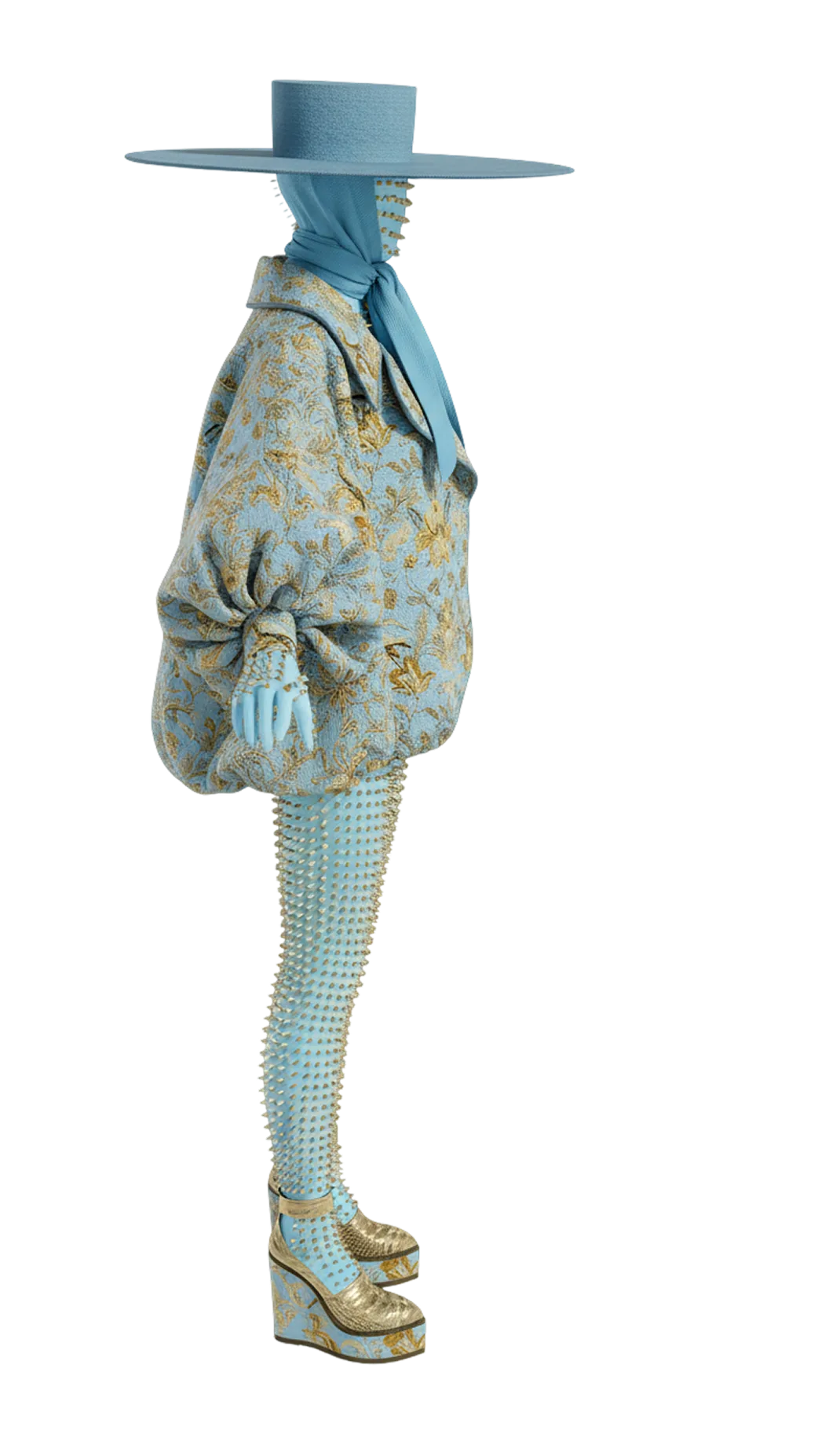
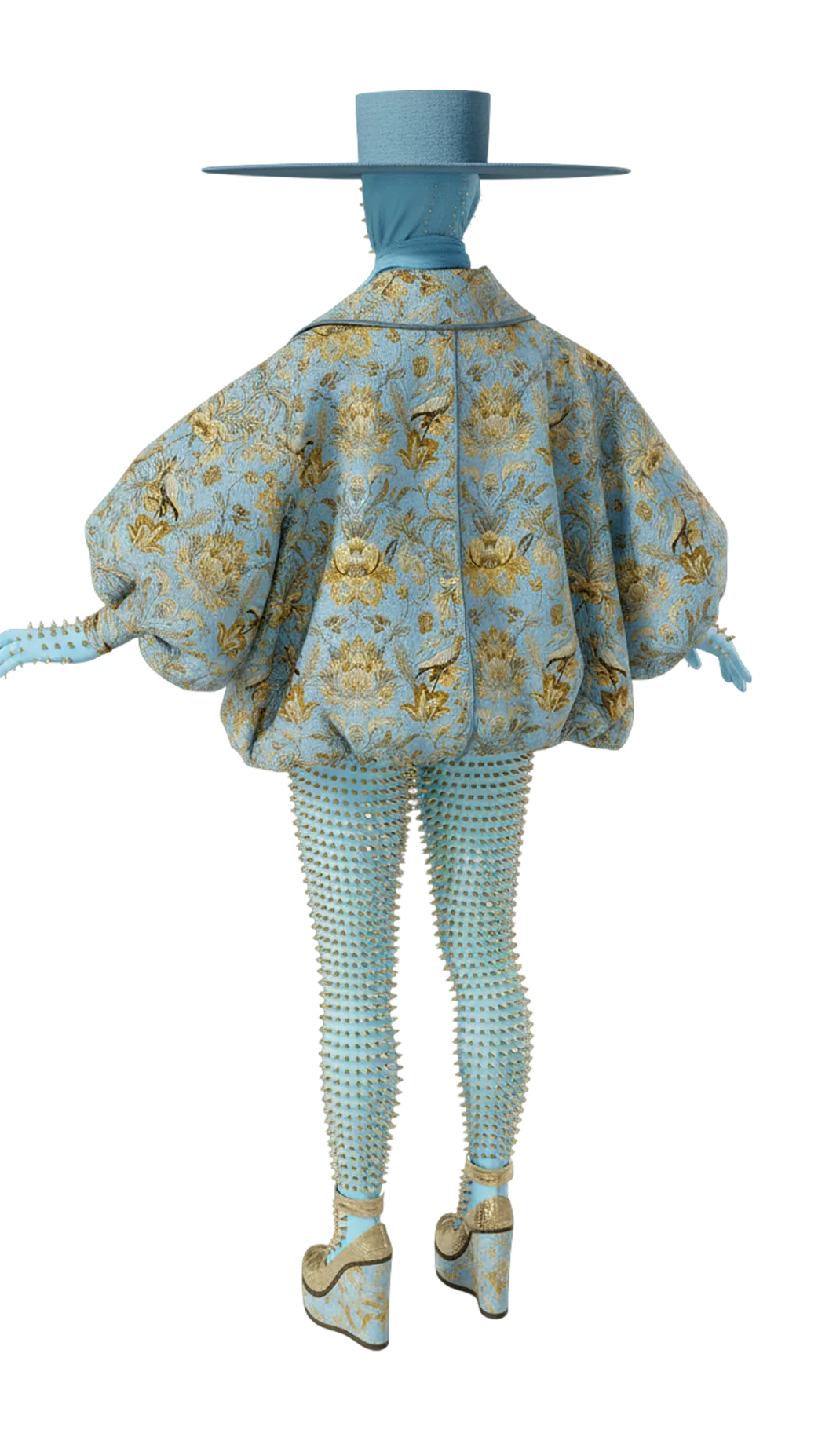
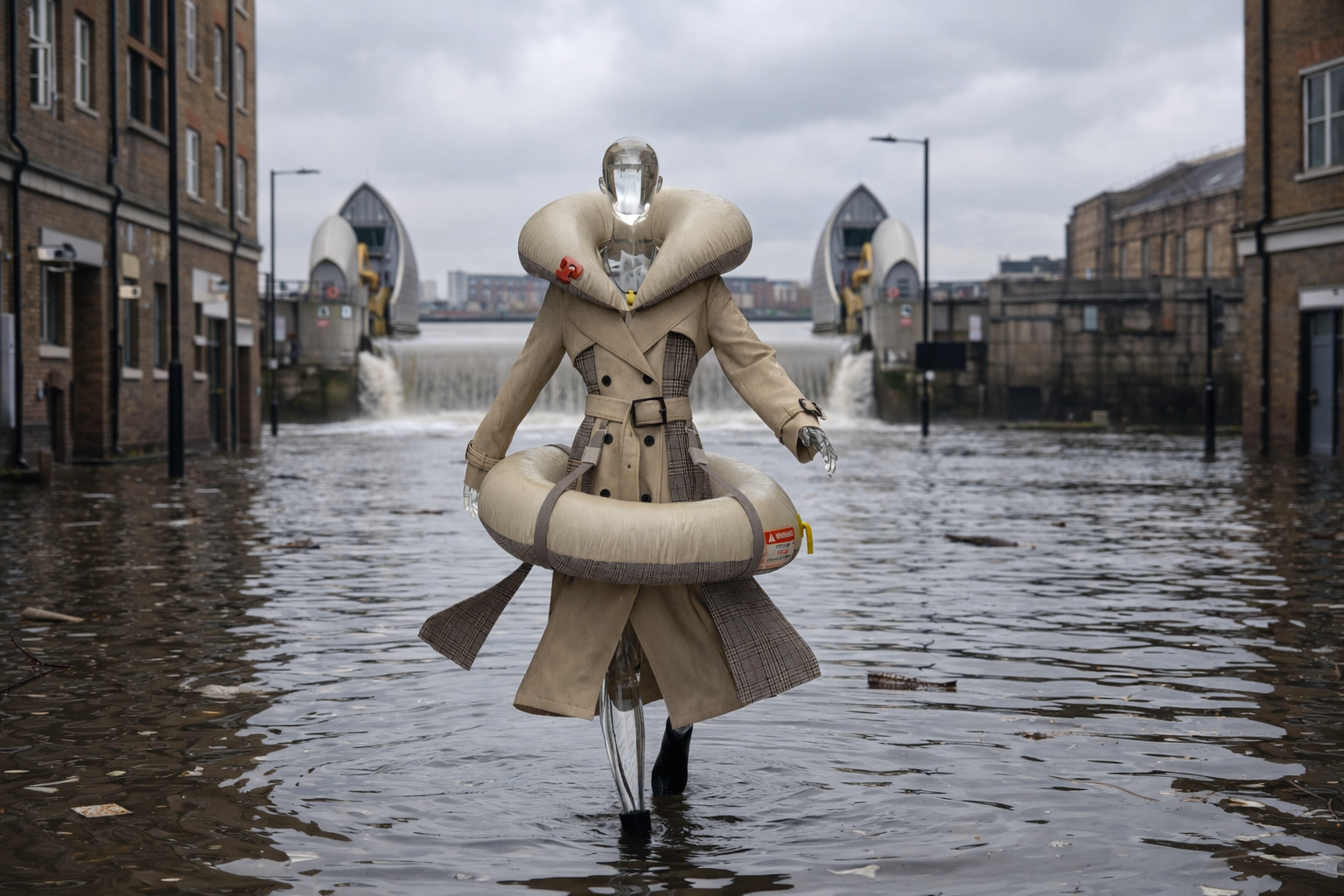
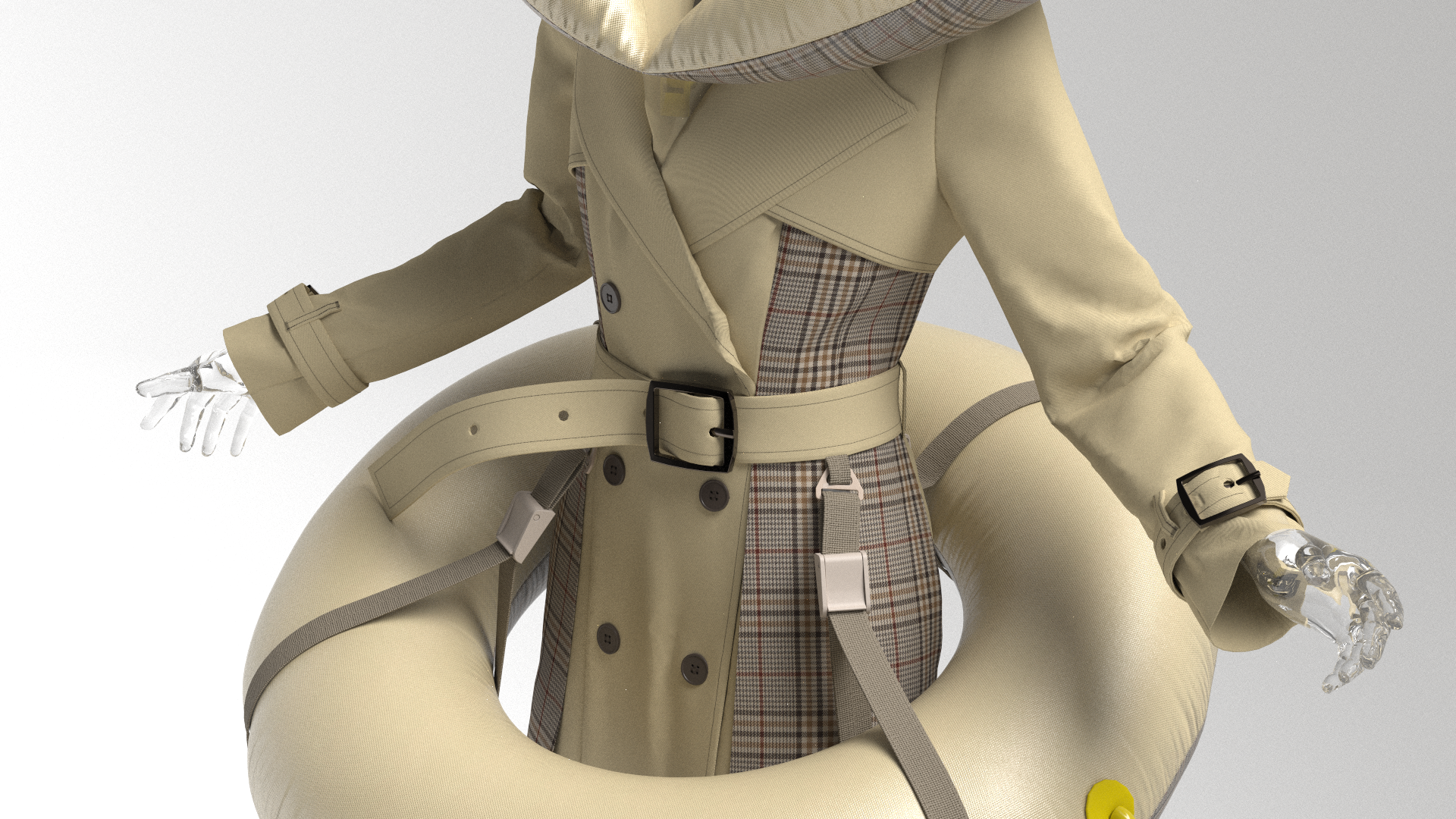
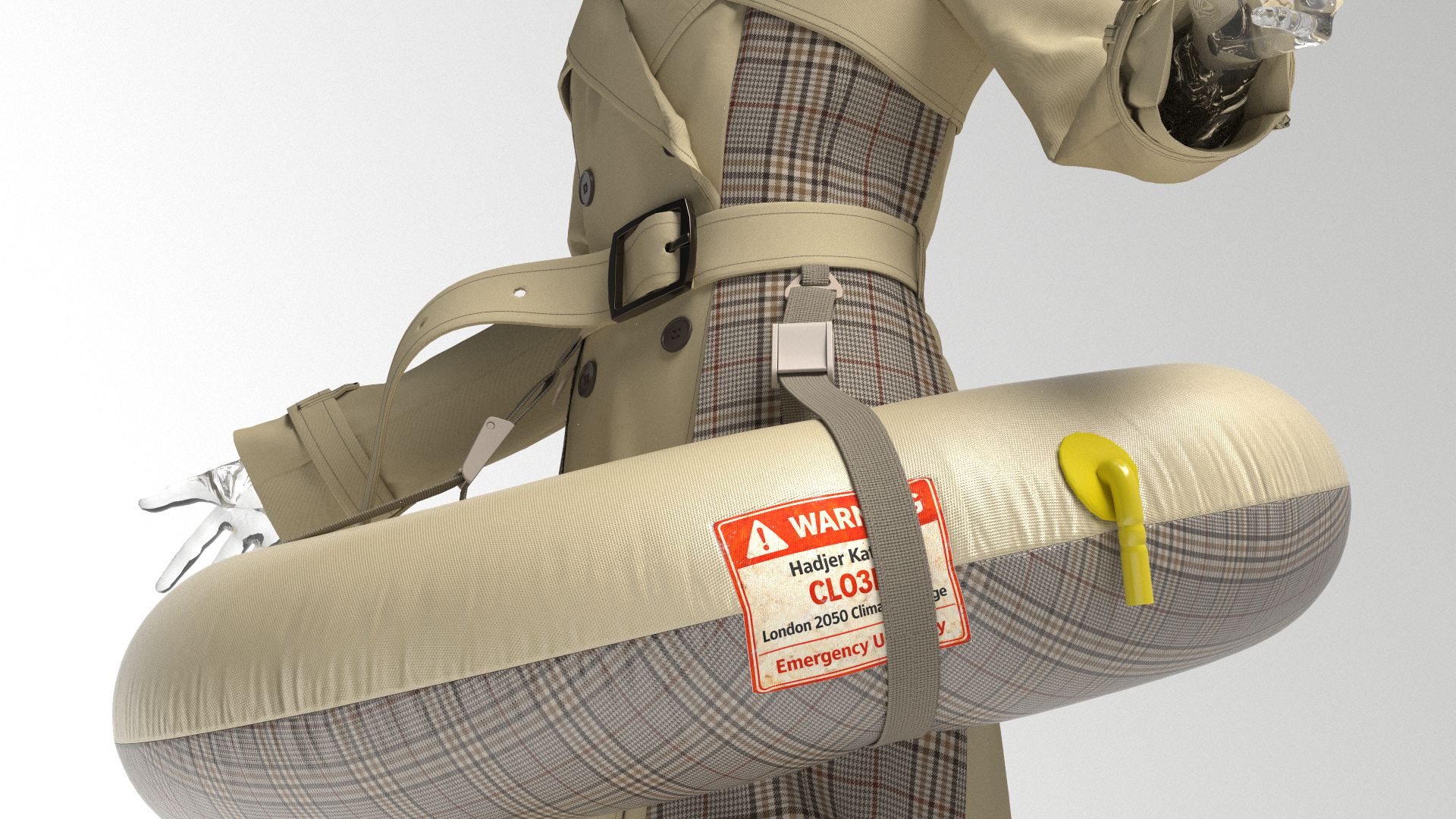
Climate anxiety is hard to talk about, so this creative trio decided to dress it up. By merging London’s iconic trench coat with emergency survival gear, "The Drench Coat" captures attention through high fashion before delivering a sharp statement about London's flood risk. Read how a copywriter, an art director, and a 3D designer subverted the luxury aesthetic to create a hauntingly functional piece of speculative activism.
Part 1: The Concept & Collaboration
Q1. (To the Team) Let’s start with the origin story. "The Drench Coat" is a brilliant yet alarming concept. How did a fashion designer, an art director, and a copywriter come together to tackle London’s flood risk?
The insight around rising water levels was something Henry & Chelsea had been discussing for a while. We wanted to create something that brought a future crisis to the forefront and made it feel tangible.
Then Henry texted Chelsea early one morning with an idea for a "Trench Coat Life Jacket", a cheeky way to draw attention to something very real. The phrase itself captured everything. Chelsea and I were immediately drawn to the idea of combining two wearable items into something entirely new, and the trench coat felt like the perfect vessel given its rich history in London. You can't go anywhere in this city without seeing one.
We both agreed that having a real fashion designer develop a bespoke look felt more authentic. Henry and I are advertising creatives so designing clothes isn't really our expertise, and it would have been an injustice to the idea to pretend otherwise. So I reached out to a London freelance group chat with a short synopsis of the project to see if anyone would be interested. Someone connected me with Hadjer, who is well-versed in garment design through CLO. I put together a brief, the three of us jumped on a call, and it all went from there.
Q2. (To Henry - Copywriter) The messaging is incredibly sharp: "High Fashion for High Waters." Why use the language of fashion to communicate climate anxiety to Londoners?
The language of fashion is something these areas of London understand. The areas of London we are trying to talk to and divert their attention to the climate crisis. So it works as a sort of a ‘trojan horse’, in that respect. It intrigues first, makes these people feel spoken to, then communicates what we really want them to know.
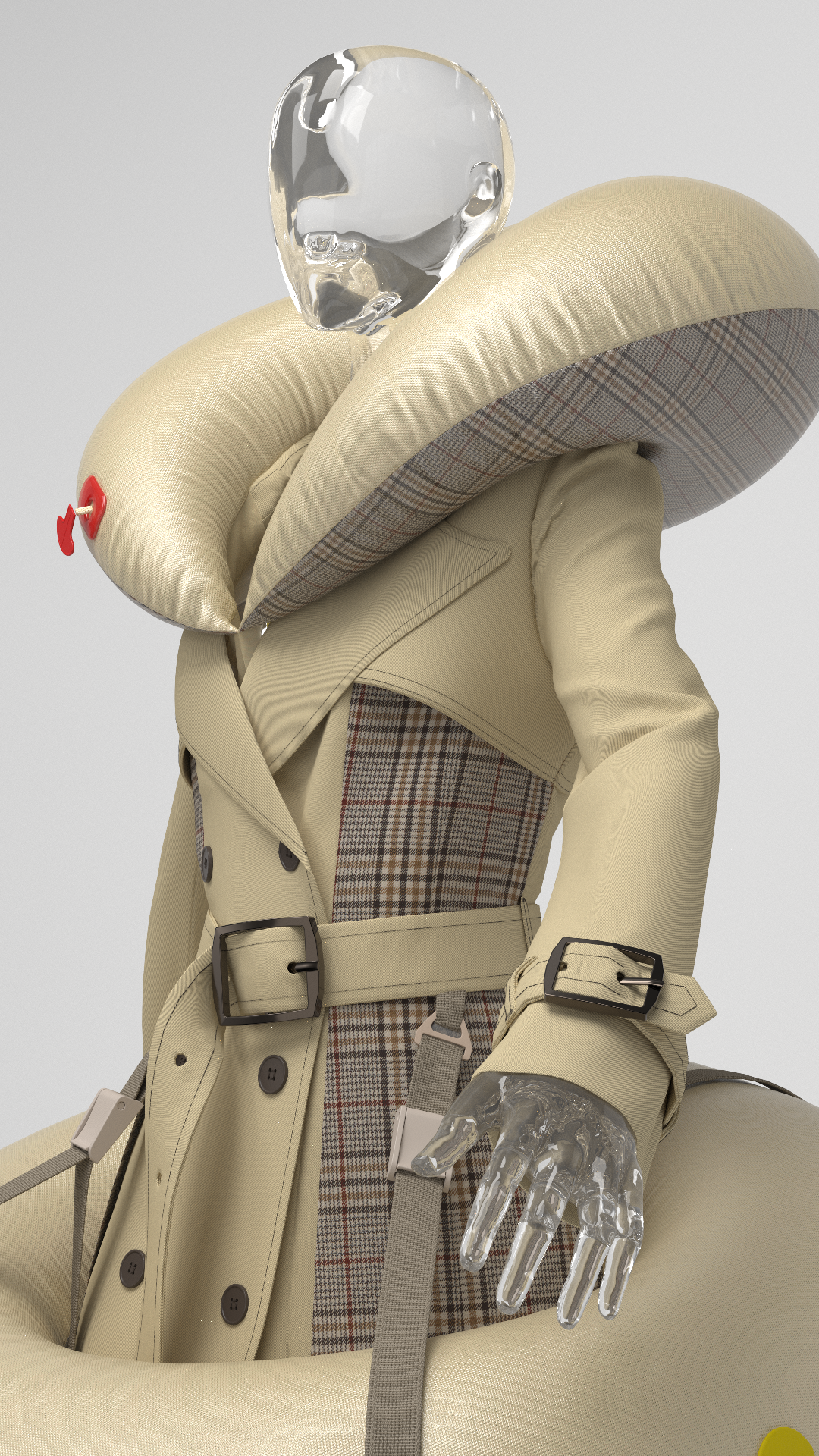
Q3. (To Chelsea - Art Director) Visually, the piece balances the classic British trench coat with emergency survival gear. What was the art direction process like to ensure it didn't look like a costume, but rather a hauntingly realistic piece of equipment?
When putting together the brief for Hadjer, I built references for the “world” we’re in vs the “world” we’re avoiding. Staying away from hyper futurism & science fiction, which are places our minds easily wander to when discussing a “future” themed design. I made sure to gather as many references for trench coats and life vests as possible. It was important to understand what makes a trench coat a trench coat — and what makes a life jacket a life jacket. While we were creating something entirely new, it only works if there's enough resonance with where each element comes from. Otherwise the story gets lost.
In our first call with Hadjer, she quickly put together an initial sketch that was a beautiful, well-crafted combination of both garments. But it was missing the statement. We didn't want this to be a project about beauty or aesthetics, we wanted to lean into the irony of climate change, and for that it needed to feel functional, almost unsettlingly practical.
After we outlined the tone and direction, Hadjer went back to the drawing board and came back with something that nailed it. Once we landed in the right direction, the momentum carried us forward.
Part 2: The Craft & CLO Workflow
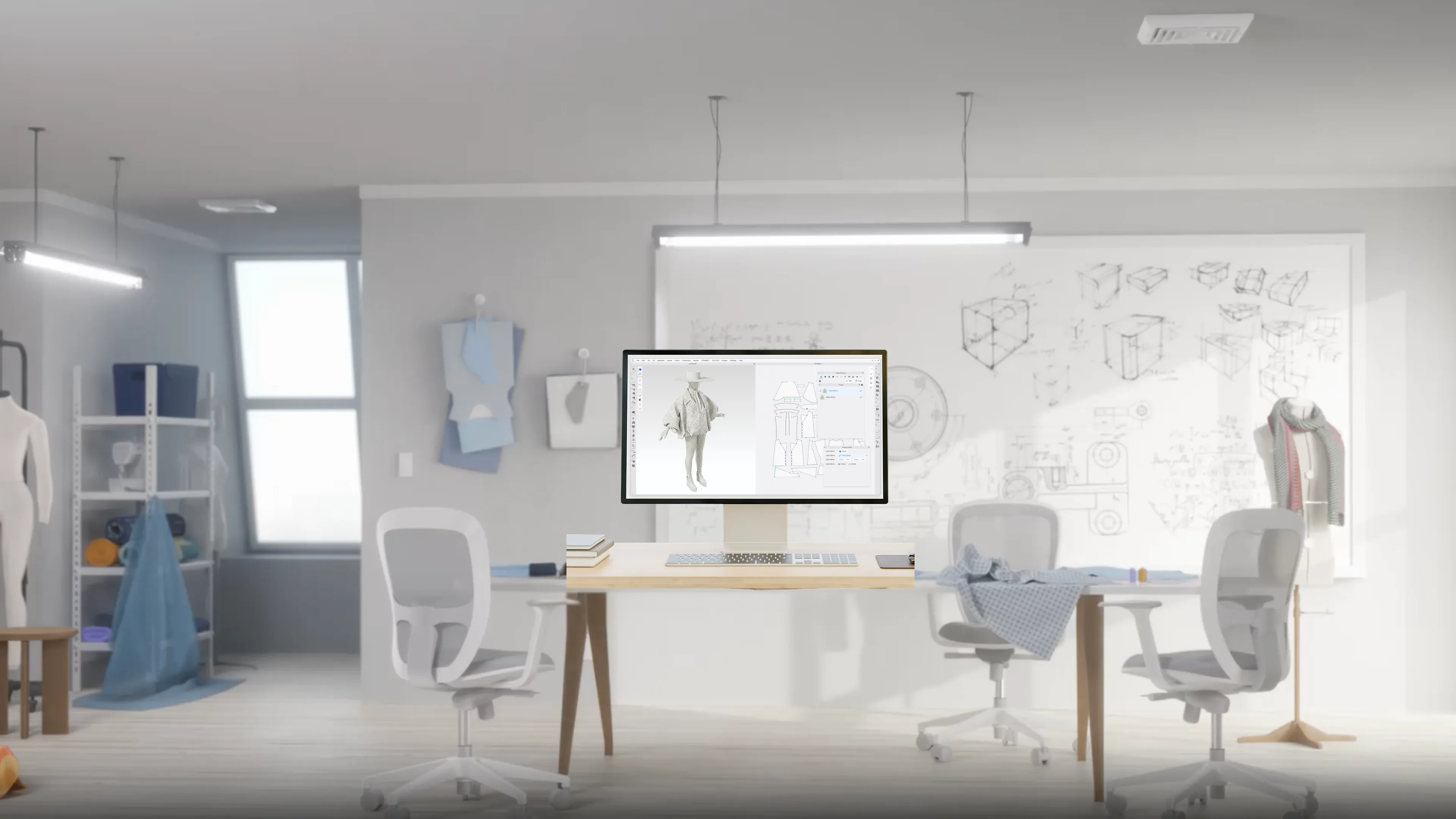
Q4. (To Hadjer - Fashion Designer) Let's talk about building this in CLO. The tailoring looks immaculate—glen plaid paneling, double-breasted hardware. What was the most challenging part of constructing the base trench coat digitally?
The base started from scratch. I drafted the patterns directly in CLO, referencing a trench coat block I’ve developed in real life, so I approached it as actual tailoring rather than building visually around an avatar.
The most challenging part was maintaining structure while introducing complexity. A trench coat already has multiple layers, overlap, and hardware, but here I was also integrating pressurized volumes and additional trims. That creates instability very quickly in CLO if everything isn’t built correctly at the pattern level.
I constructed the double-breasted front with a real overlap and handled fit adjustments directly in 2D, the same way I would in physical pattern making. That gave me control over proportion and balance instead of relying on surface-level tweaks.
The main technical challenge was keeping the garment stable during simulation and animation. With multiple fabric layers, different pressure values for the inflated sections, and custom trims, the system can easily break or behave unpredictably. A lot of the work went into refining pattern relationships, managing how pieces interact, and making sure the garment holds its shape under those conditions.
Where I think I had an advantage was speed. Because I’m comfortable with pattern construction and CLO’s core tools, I’m not spending time troubleshooting basic issues. That lets me move quickly through iterations and focus most of my time on pushing the design and resolving the garment at a higher level rather than just getting it to work.
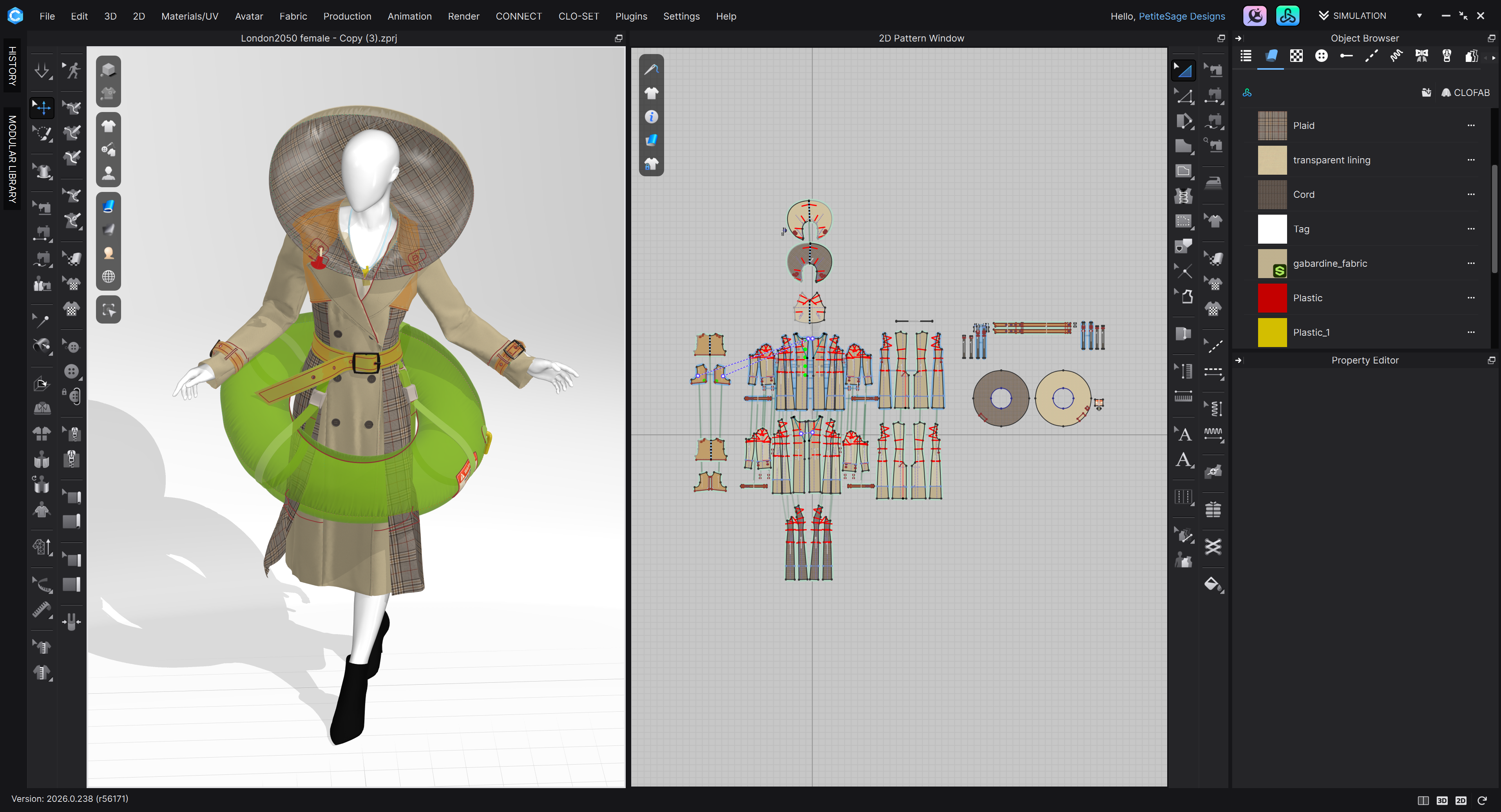
Q5. (To Hadjer - Fashion Designer) Integrating the survival elements—the oral inflation valve, the whistle, the webbing straps—must have been complex. Did you use any specific CLO tools or workflows to integrate these hard-surface objects with the soft fabrics?
That part was definitely the most technical because I was combining soft fabric simulation with hard trims and inflated volumes, which don’t naturally behave well together in CLO.
For the inflatable sections, I applied pressure to cloned pattern layers with opposing values to create the realistic expansion. Then I controlled the timing in the Animation Editor so the garment transitions cleanly between flat and inflated states.
For the hard surface elements, I used a mixed workflow depending on what made the most sense. The whistle was built in Blender and brought into CLO as a trim, and the tube was done quickly in Nomad Sculpt to keep things efficient. The red pull detail, on the other hand, I built directly in CLO. I also used CLO’s buckle library where it worked, instead of overcomplicating it.
The straps are fully constructed as pattern pieces with a strap material, so they behave correctly in simulation. For attaching everything, I used a combination of sewing, arrangement points, bonding, and glued trims, basically following real garment logic rather than just placing things visually.
The main challenge wasn’t building the elements, it was keeping everything stable. With multiple layers, pressure values, and trims, it’s easy for the simulation to start jittering or breaking. So I worked very incrementally, simulating after each addition and resolving any collision or instability before moving forward.
The only part that’s more visually driven is the inflation mechanism itself. Everything else is built to behave as accurately as possible within CLO.
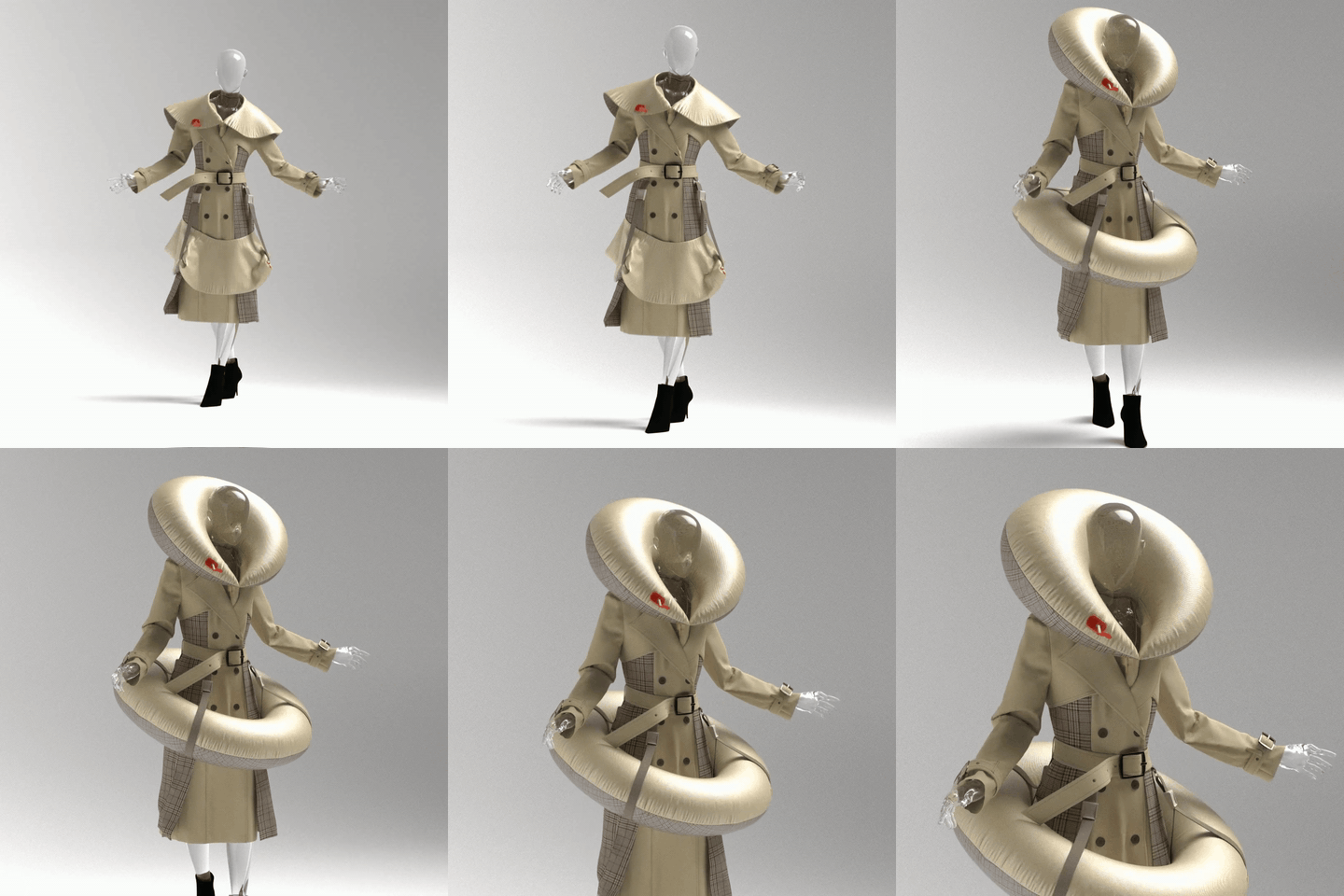
Q6. (To the Team) The texturing and rendering are what make this piece so believable. How did you approach the fabric properties and lighting to achieve that photorealistic finish?
Since this is a more technical question, we’re letting Hadjer take the lead on this one.
[From Hadjer] – For me, realism really starts at the fabric level. If the material doesn’t behave correctly during simulation, no amount of rendering will fix it, so that’s always where I focus first.
I used a mix of sources depending on the need. Some fabrics came from Adobe Substance assets, others from Sunwell files on CONNECT, and in a few cases I built them directly in CLO using CLOFAB to generate my own maps. That was especially important for the flotation material. I needed a very specific texture, but I didn’t want it to read as plastic, so I spent time adjusting both the maps and the physical properties until it felt believable.
For the glen plaid, I worked from a full texture file and then refined the scale and placement so it sits correctly on the garment. It’s a small detail, but if the scale is off, the whole piece starts to feel digital.
In terms of simulation, I’m constantly adjusting fabric properties as I build. Things like weight, stiffness, and thickness make a big difference in how the garment reads. Even early on, I’ll reduce particle distance on smaller or more detailed pieces so they drape properly, rather than waiting until the final render. Then at the end, I push the render quality as high as my system allows to clean everything up.
The design itself is fairly controlled, so I wasn’t relying on random folds. When I needed them, I used multiple internal lines to guide how the fabric breaks, so the folds develop gradually and feel intentional. If I want something sharper, like a pleat, then I’ll use a single internal line instead. That level of control makes a big difference in how clean the garment reads.
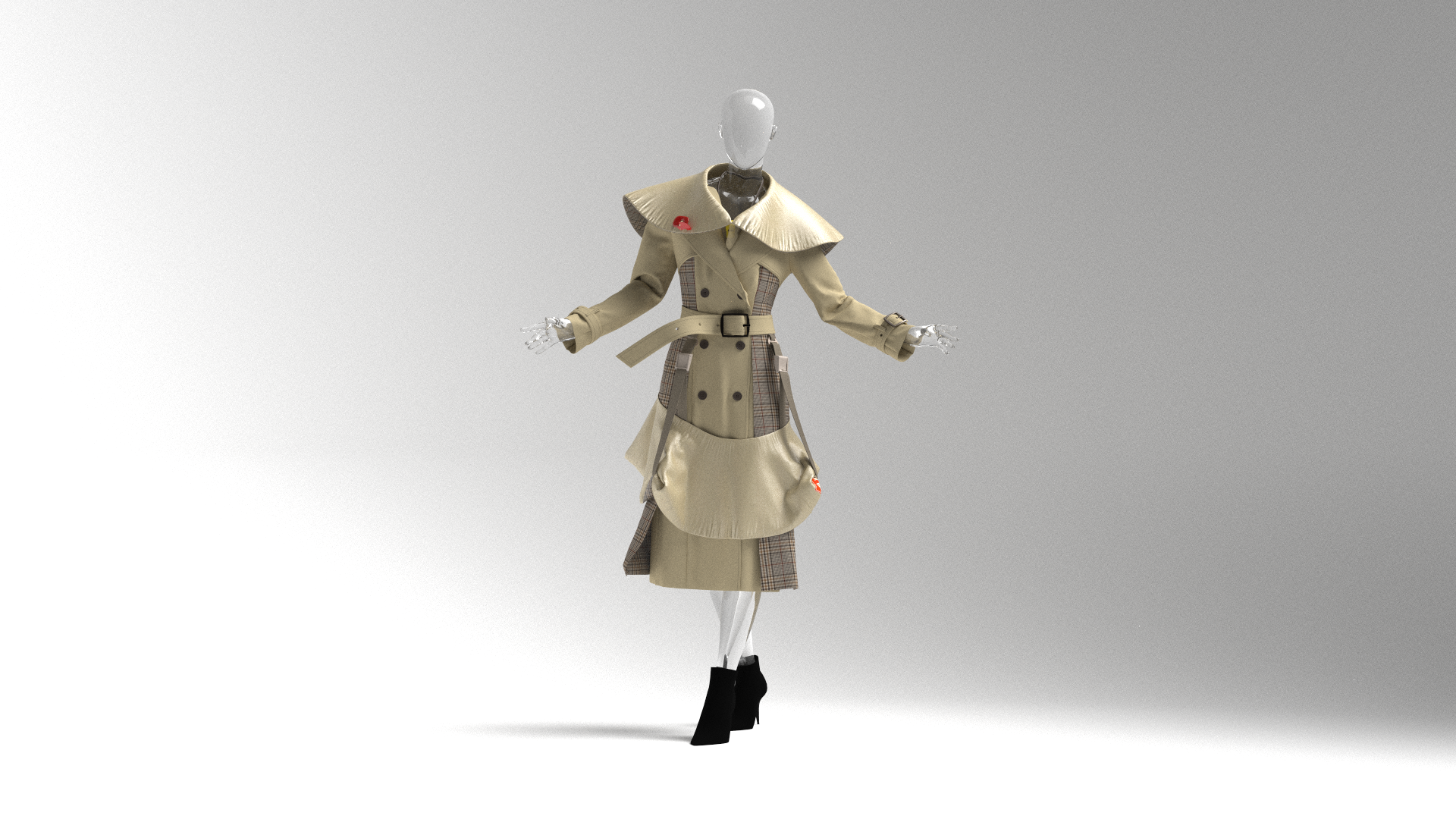
Lighting is what actually makes the texture visible. You can have the best maps and fabric setup, but if the lighting is flat, everything reads as one surface. I built a custom lighting setup by positioning lights manually and controlling their intensity, size, and direction specifically to catch highlights and shadows across the material. That’s what brings out depth, surface variation, and makes the fabric feel real instead of digital.
I tested HDRIs and more dramatic setups as well, but we chose a cleaner configuration that still allows the texture to read clearly without overpowering the garment.
In the end, it really comes down to the relationship between fabric behavior and lighting. Texture is there, but lighting is what reveals it.
Part 3: Impact & The Future
Q7. (To the Team) As a digital-only garment (for now), you bypass the physical waste of traditional fashion. Do you think 3D design is the most effective tool for "conceptual fashion" and activism today?
We do think 3D design is one of the most effective tools for conceptual fashion right now, especially when the goal is to communicate an idea quickly and clearly. It allows you to combine design, prototyping, and storytelling in one process, without the time and material waste you’d normally have in physical development.
For something like this project, it’s really about awareness. You can take a concept that would be difficult or expensive to produce physically and still present it at a level where people take it seriously. That speed and clarity make it very effective for activism and speculative design.
At the same time, it doesn’t replace everything. You still don’t have the physical experience of the garment, how it feels on the skin, how materials interact in reality. That part is still essential, especially when you move toward production.
[From Hadjer] – In my case, I use CLO as a real design tool. From a technical standpoint, I’m building garments the same way I would physically, through pattern making, fit, and material behavior. But creatively, it also gives me the freedom to test ideas that would be difficult to execute in real life.
One thing I think is often misunderstood is the difference between digital fashion and digital prototyping. A lot of people see 3D garments as purely visual or tied to gaming, but in reality, it’s a technical process. You’re working with fabric physics, construction, and fit. When it’s done properly, you’re essentially creating a digital version of a real garment that could go straight into production.
And just because it’s faster doesn’t mean it’s easier. The speed comes from knowing what you’re doing. Otherwise, you still run into the same problems you would in physical design, just in a different environment.
Q8. (To the Team) You are planning a physical version for London Fashion Week. How has designing this first in CLO prepared you for the physical production phase?
Designing it in CLO first gave us a clear understanding of the garment before anything physical exists. Being able to show a version of a CLO design that's public facing has also helped us gain interest in “flood fashion” in general before moving to next steps. We aren’t guessing proportions or construction, we’ve already built and tested them at the pattern level.
Because we drafted everything from scratch, we already know how each piece comes together, how the volume is distributed, and how the garment sits on the body. That removes a lot of the trial and error you would normally have in early sampling.
[From Hadjer] – It also helped identify where the complexity actually is. The base trench is fully resolved, so the focus going into production would be on engineering the functional elements, especially the inflatable sections and hardware, rather than redesigning the garment itself.
At the same time, it makes the limitations clear. CLO gives you a very good representation of behavior, but you still don’t have the physical feel of materials. So the next step would be translating those fabric choices into real-world equivalents and testing how they interact.
Overall, it speeds up the process and makes it more controlled. You go into production with decisions already made instead of figuring them out as you go.
Q9. (To the Team) Many of our readers are individual freelancers or students who want to create meaningful work. What advice would you give to creatives who want to use 3D design for social or environmental causes?
Build around one single idea with as much craft as you can. The concept gets people interested but the execution is what makes them take it seriously. Start with a clear point of view. The tool doesn’t make the work meaningful, the idea does. If the message isn’t strong, no level of rendering or technical skill will carry it.
[From Hadjer] – Use 3D to test and push ideas that would be difficult to explore physically. The advantage is speed and flexibility, so take advantage of that. Iterate quickly, try different directions, and refine until the concept feels resolved, not just visually appealing.
At the same time, treat it like real design. Build your garments properly, understand pattern making, and learn how fabrics behave. That’s what makes the work convincing. If it only looks good from one angle, it won’t hold up.
Also, don’t limit yourself to what feels “realistic” at first. Some of the most interesting work comes from testing ideas that wouldn’t normally be produced. You can always bring it back to reality later if needed.
And finally, be intentional with how you present it. Lighting, pose, and context matter just as much as the garment. If you’re trying to communicate something, everything in the image should support that message.